
Have you fallen into the trap of break-fix irrigation work being your primary revenue source? When first getting started with an irrigation business, it is often the case that your initial customer base will be residential properties that called your business because a visible issue caught the homeowner’s attention and it needs to be fixed. If you are savvy, you will convince the homeowner to pay you for your time checking the rest of the system to see if there are additional issues that need repairs.
Why is this a trap? Because you are relying on the homeowner or property manager to find the issue and call you. This isn’t sustainable. You likely get a rush of calls at the beginning of the season and then at peak heat. Scheduling becomes a challenging, especially with customers that see a problem and just must have it fixed today, else they are calling around. It is also a roll of the dice if they will let you inspect the rest of the system, especially for a fee. Wouldn’t it be better for your business to have a more consistent flow of appointments, with customers that want their system running flawlessly?
Welcome to Irrigation Maintenance Programs!
What is a Maintenance Program?
Instead of responding to repair calls, a maintenance program is a contractual agreement that provides a pre-determined number of site visits to inspect and repair the irrigation system. The customer agrees upfront with a schedule, the cost of the inspections, and repair contingencies. The terms of the program depend on the type of customer.
Residential customers have different needs and price sensitivity compared to commercial property owners. Residential customers likely need a system startup visit and a mid-season checkup before temperatures peak. In areas that winterize, they also need a shutdown service. All of these should be packaged into the contract.
Commercial property owners have other priorities, such as code compliance for un-attended leaks or scheduling errors, employee and customer satisfaction impacts if cars are getting sprayed, and general public perception due to increased awareness around water conservation. Commercial properties may need to be visited monthly and have faster response times.
Common “features” of a Maintenance Program contract:
- Periodic system inspections (# of visits ___ )
- Check controller settings; ensure proper program timing
- Run all zones and call-out issues
- Outline repair cost schedule
- Are there any services that are included? (eg. nozzle adjustments)
- Do you charge Time & Material or by the repair?
- Is there pre-authorization for repairs up to a certain cost?
- Define response times for service calls between visits (eg. 24hr on-site after notification)
How Do You Price and Pitch It?
As mentioned above, you will likely craft multiple offerings depending on the type of customer. Pricing is always an exercise of figuring out how high you can go while providing enough volume of business to keep the schedule full. Justifying the price comes down to understanding and communicating the benefits to the customers. There a several that are common across all programs:
- Purchasing the program gets the contracted visits on the calendar ahead of all new service calls
- Service calls between visits get higher scheduling priority
- Familiarity with the irrigation system makes future visits more efficient, saving labor costs and ensuring the correct parts are on the truck
- If suggested repairs are completed, the system is running as designed with the most efficient programming setup
There are several things to consider when determining how to price the programs. First, the money to be made is in repairs and upgrades. Performing the system checkup enables you to do both. This allows you, the professional, to get eyes on the complete system and not the one area the property owner noticed and made a service call about. When informed of other system deficiency, often the property owner will agree to those repairs on the spot.
Second, after the first visit and round of repairs, all follow-on visits for the season will likely be without major repair needs. Your on-site time will be dramatically lower than had it been the first time visiting.
Third, determine whether you want to offer a discount for pre-paying for the season. This is a great way to improve cash flow and stabilize your schedule.
Example: Commercial 10-zone property
Controller and Program Review: 10min
Zone wet-check (5min per zone): 50min
Total on-site time (not including repairs): 60min + 30min trip time @ $120/hr → $180
6 monthly visits (April – Sept) → $1080 program total or $972 with 10% pre-pay discount
Streamline Your Process
One way to minimize your on-site time when performing the follow-up checkups is to have a system in place to record the property and system characteristics. Having information such are zone descriptions and controller type already stored in a client/property record means that you only need to mark off deficiencies the next time you visit.
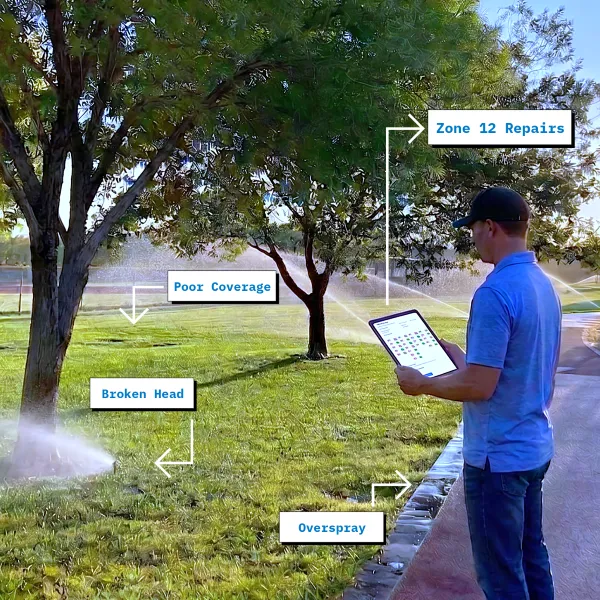
An app like IrrigationCheckups.com has the capability to record backflow, controller, and individual zone information and guide users through performing system inspections. Once complete, a professional looking report is created that will impress both residential and commercial property owners. Over time, you will have the data necessary to give insights on how much and what type of spare parts inventory to carry on the truck.
Upsell and ROI
Once you are familiar with a property and the existing irrigation system, you can then provide professional suggestions on system upgrades to improve water efficiency and landscape health. In areas with skyrocketing water costs, you can begin to estimate water savings and the relatively short return on investment periods for upgrades like smart controllers and rotary nozzles.